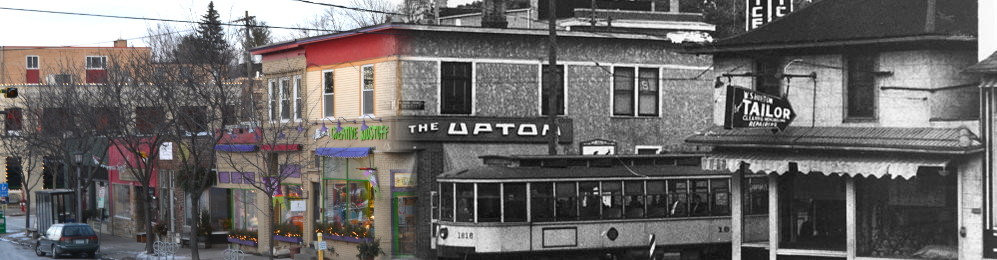
The Westgate Theater opened in 1935 as a neighborhood showplace in Edina, across Sunnyside Road from the Convention Grill. For decades it survived on second‑run features, long after bigger downtown houses had shown them. Yet this modest venue became legendary when it held Harold and Maude on screen for 115 weeks — an unprecedented run that turned a quirky comedy into a cult phenomenon. In Held Over, author John Gaspard traces the theater’s journey from its grand opening through its unlikely brush with history, capturing how one small movie house helped shape the legacy of a film and a generation of moviegoers.
It took Courage: Eliza Winston’s Quest for Freedom
Dr. Christopher P. Lehman, author of It Took Courage: Eliza Winston’s Quest for Freedom, will talk about the life of enslaved woman Eliza Winston and her persistence in her pursuit of liberation. Born in 1817, she spent her childhood and early adulthood enslaved by President Andrew Jackson’s family in Tennessee. In 1860, after seven years in Mississippi, her enslavers took her on their vacation to Minnesota. There, she found allies who helped her successfully plead her case for emancipation. She became the first and only enslaved person freed through Minnesota’s courts.
20th Century – Excelsior and the South Shore
At the turn of the century, mammoth steamboats and tourism began to leave the lake and Excelsior township and village began to dissolve into five communities, with Excelsior taking its place as the downtown of the south shore. Served by the streetcar from the Twin Cities and home to the popular Excelsior Amusement Park for almost fifty years, tiny Excelsior’s history is still evident today. Joanie Holst with the Lake Minnetonka Historical Society will share Excelsior’s rich history.
Highlighting the Role of A. O. Hoyt in early Linden Hills: Walking tour with Peter Sussman
Alphonzo O. Hoyt first viewed Lake Harriet in 1882 as a conductor on the steam powered Motor Line. Through 1923 he helped shape Linden Hills, initially with Henry Beard, then as manager of the first Lake Harriet pavilion in 1888 and finally in platting Hoyt’s Crestmont Addition to Minneapolis. Peter Sussman will share the origins and changes along the west side of Lake Harriet on our walking tour.
Meet at the northwest corner of Queen Avenue S. and Linden Hills Boulevard (4290 Queen Ave. S.)
The tour will be held rain or shine, except if an electrical storm is forecasted for the day of the event.
Highlighting the Role of A. O. Hoyt in early Linden Hills: Walking tour with Peter Sussman
Alphonzo O. Hoyt first viewed Lake Harriet in 1882 as a conductor on the steam powered Motor Line. Through 1923 he helped shape Linden Hills, initially with Henry Beard, then as manager of the first Lake Harriet pavilion in 1888 and finally in platting Hoyt’s Crestmont Addition to Minneapolis. Peter Sussman will share the origins and changes along the west side of Lake Harriet on our walking tour.
Meet at the northwest corner of Queen Avenue S. and Linden Hills Boulevard (4290 Queen Ave. S.)
The tour will be held rain or shine, except if an electrical storm is forecasted for the day of the event.
Puppetry in the Twin Cities – Jennings Mergenthal – 2026-03-09
Minneapolis Post-War Places of Worship – Bobak Ha’Eri – 2026-01-26
The Most Competitive Passenger Train Corridor: Chicago-Twin Cities – Aaron Isaacs – 2025-12-06
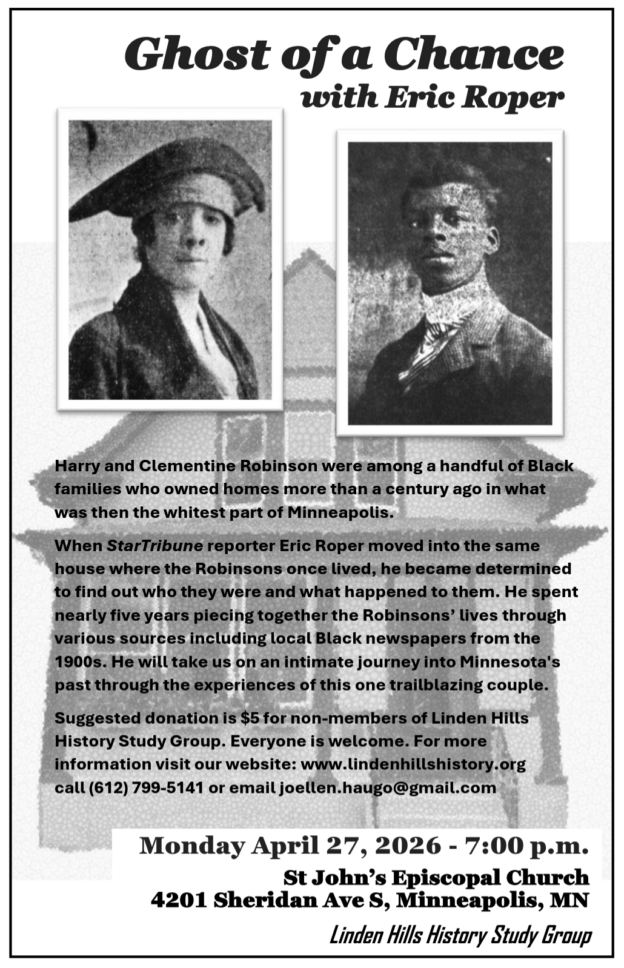
Ghost of a Chance with Eric Roper
Harry and Clementine Robinson were one of a handful of Black families who owned homes more than a century ago in what is now the whitest part of Minneapolis. When Star Tribune reporter Eric Roper moved into the same house where the Robinsons lived, he became determined to find out who they were and what happened to them. He spent nearly five years piecing together the Robinsons’ lives through genealogy records, old public documents, and fascinating tidbits from articles in local Black newspapers from the 1900s. He, with a team of other staff members and community members, wrote a series of articles published as a special insert in the Star Tribune. In addition, they created a six-episode podcast that takes listeners on an intimate journey into Minnesota’s past through the experiences of this one trailblazing couple.
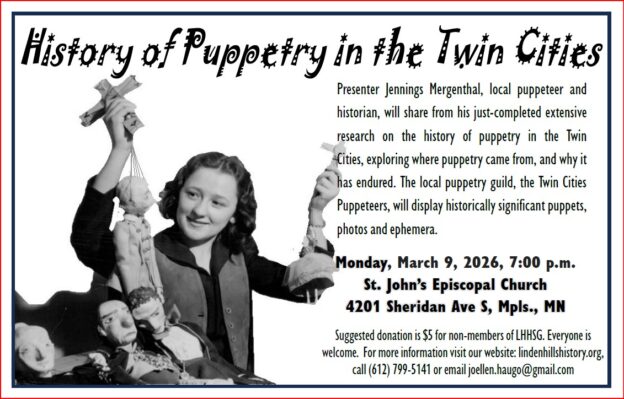
History of Puppetry in the Twin Cities
Local puppeteer and historian, Jennings Mergenthal, has just completed an extensive research project focused on the history of puppetry in the Twin Cities, exploring where puppetry came from and why it has been so enduring. The local puppetry guild, the Twin Cities Puppeteers, will display historically significant puppets as well as photos and ephemera.